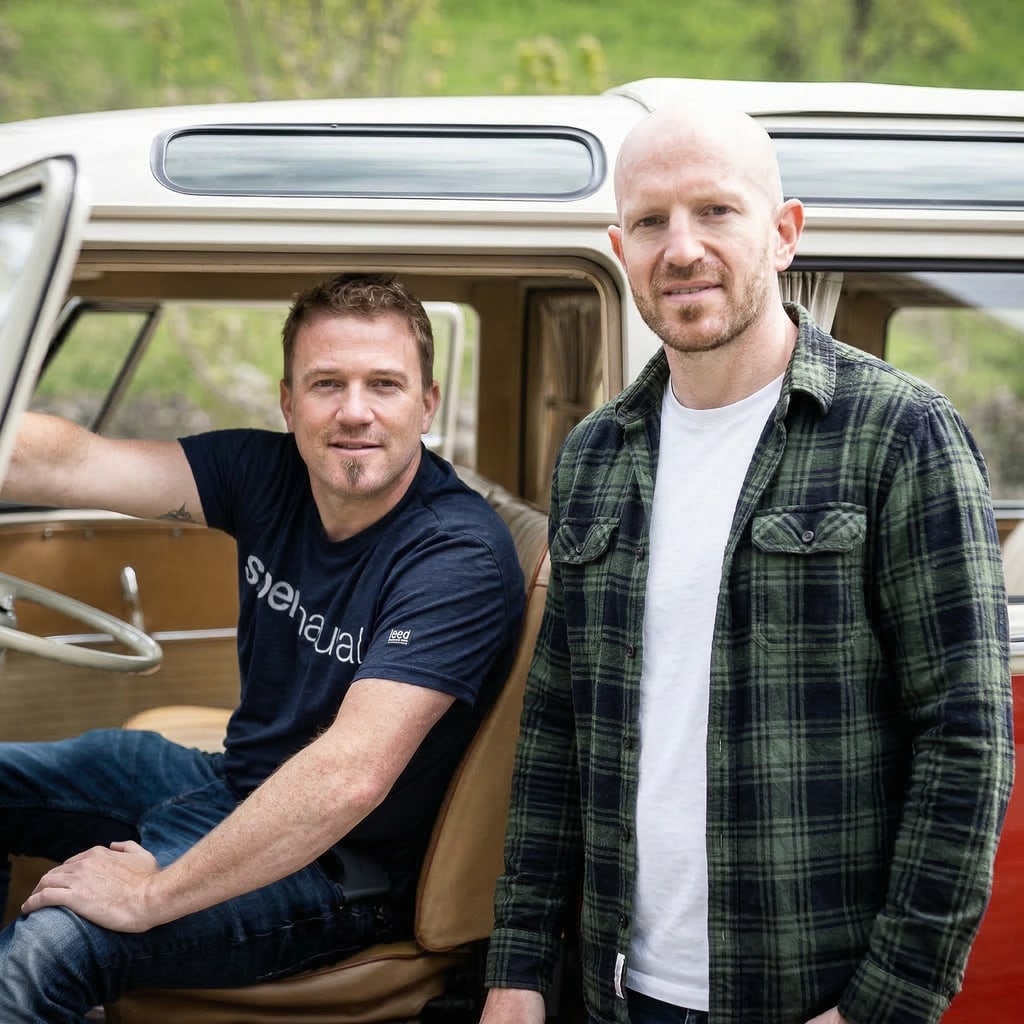
Lukas Imhof (CEO and Co-Founder) and Daniel Jäger (CFO and Co-Founder)
Tuesday, April 7, 2026
Reading Time: 6 min
From Break-Even to Breakout: How Parkn'Sleep Is Scaling a Capital-Efficient Camping Platform
After reaching operational break-even in 2025, Parkn'Sleep is entering its next phase with a clear thesis: scale what already works. In this conversation, founder Lukas Imhof explains how the company validated product-market fit and built unusually strong unit economics on just CHF 347,000—while keeping support costs below 1% and acquisition costs at CHF 1.65 per user. For founders, it’s a case study in disciplined execution and simplicity over complexity. For investors, it’s a look at a platform leveraging automation, on-site demand, and a strategic move into hardware to capture a fragmented €20 billion market—without relying on venture capital to survive.
OOMNIUM: You reached operational break-even in 2025 and are now raising Round 2 at a higher valuation. How did you use the CHF 347,000 from your first OOMNIUM round to validate both product-market fit and sustainable unit economics?
Lukas Imhof (L.I.): We deployed the capital toward platform development, expanding our host network, and real-market validation through actual hosts and bookings. The critical focus was ensuring that every booking was economically sound and that we had a foundation for a scalable platform business.
Growth without functional unit economics delivers nothing.
OOMNIUM: Your founding team has collectively built and exited multiple companies before Parkn'Sleep. What fundamental lessons from your previous entrepreneurial experiences shaped how you've approached building this platform differently?
L.I.: The most important insight is that simplicity wins. Many startups build too much complexity and lose themselves in features. We're intentional about automation, standardized processes, and a step-by-step rollout of new revenue streams. We validate existing revenue channels before adding new ones. Growth without functional unit economics delivers nothing. Speed is often more decisive than the perfect solution.
OOMNIUM: You're deliberately allocating 40% of this round's capital to Pitch Control—a hardware-based solution launching Fall 2026. Given the traditional complexity and capital intensity of hardware, why did you choose to build this as part of your core strategy rather than partner with third parties?
L.I.: The market is physical, and software alone doesn't fully solve the problem if you want to reduce operational overhead. Pitch Control makes a smart move into the reservation business and expands our addressable market into the core camping industry. The hardware is manufactured by our partner and exclusively licensed to us. It already exists and doesn't require expensive development.
OOMNIUM: With support costs at only 0.8% of bookings and customer acquisition costs of just CHF 1.65 per user, your platform demonstrates exceptional efficiency. How did you intentionally design processes and automation to achieve these metrics, and what would you tell founders struggling with scaling costs?
L.I.: The entire user journey is built around self-service with minimal operational and communication overhead from hosts. Because check-in—and the purchase decision—happens on-site, support is compressed into a few minutes. That's what makes low nightly rates economically viable. Additionally, physical elements like signage and future Pitch Control hardware serve as direct marketing and onboarding channels. Users are generated at point-of-sale, which results in much lower acquisition costs.
OOMNIUM: You've made a public commitment that founders only draw salaries once they're fully funded from operations—not from fundraising capital. What drove this decision, and how has this constraint shaped your strategic priorities and capital discipline?
L.I.: This isn't about sacrifice; it's about our structure. Each of us has side projects, mandates, and some already-successful exits in the background. We're not dependent on funding ourselves from the company. That gives us two advantages: First, we can deploy capital entirely into growth rather than fixed costs. Second, we work exactly where we have the most leverage—each person contributes what they do best. At the same time, the platform is architected to run highly automated with minimal operational overhead. That reduces personnel needs and makes this setup possible in the first place.
There's no dominant player and no existing infrastructure that adequately serves today's travel needs.
OOMNIUM: The European camping market is EUR 16–20 billion annually but remains largely analog and fragmented. When you identified this structural digitalization gap, what made you confident that a standardized platform could penetrate such a fragmented, decentralized market?
L.I.: From my perspective, there are three factors that drive platform success: the market, the moment, and the technology. There's no dominant player and no existing infrastructure that adequately serves today's travel needs. That creates the opportunity to establish a new standard. With over 10,000 campsites and more than 70,000 users across Europe, we've built a relevant base to assume that role. The next phase is professionalizing market participants—hosts, campers, and destinations.
OOMNIUM: This round is explicitly "acceleration capital, not survival capital." How does that positioning change the way you think about capital allocation, team building, and strategic risk-taking compared to your first round?
L.I.: This financing round is fundamentally different from earlier ones. We reached operational break-even in 2025 and fund our ongoing operations from our own cash flow. That means: we're not raising capital to extend runway or test unvalidated business models. "Acceleration capital" means we now apply more pressure to our proven engine—expanding the existing network, driving utilization higher, and scaling proven revenue drivers like Pitch Control.