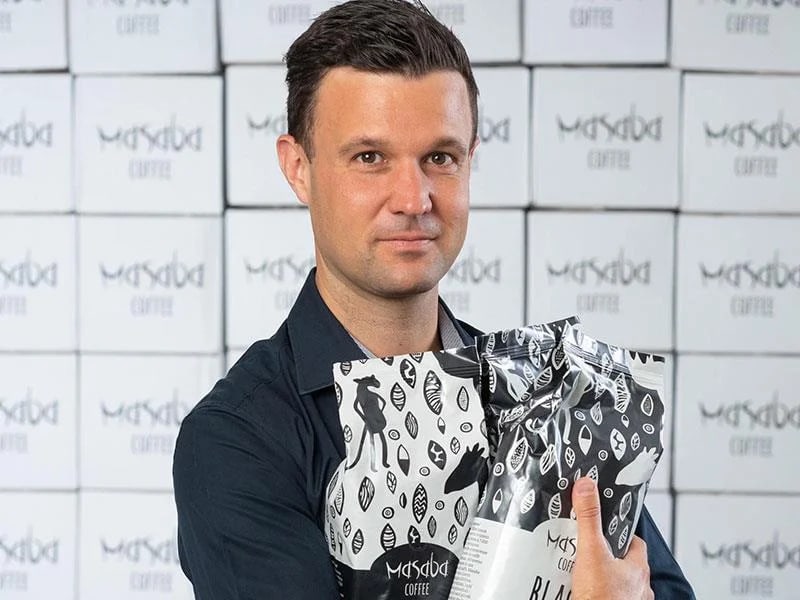
Jean-Claude Luvini (CEO and Founder of Masaba Coffee)
Thursday, Jan 22, 2026
Reading Time: 6 min
How Masaba’s founder raised 1M CHF in a mountain hut - One phone call at a time
Fifteen years ago, Jean-Claude Luvini returned from Uganda with a suitcase of coffee beans - and zero experience in sales, marketing, or the coffee industry. Today, Masaba is a beloved Swiss brand, served at the World Economic Forum and Zurich’s elite offices. But the journey wasn’t easy. In this interview, Luvini reveals how he bootstrapped the company from Christmas fairs to corporate events, why he resisted outside investment for over a decade, and how OOMNIUM’s private round transformed Masaba from a scrappy underdog into a community-powered success. Here’s how he did it, one phone call, one investor at a time.
OOMNIUM: Jean-Claude, you started Masaba 15 years ago with no prior experience in coffee, marketing, or sales. What inspired you to take that leap?
Jean-Claude Luvini (JC.L.): Yes - it all began after a trip to Uganda. I came back with no background in coffee, no marketing strategy, no sales experience. I just started small: selling at Zurich’s lake markets, Christmas fairs, even going door-to-door in Lugano, bar to bar. The office environment became our best fit -so we focused on bringing Masaba to workplaces. We’d sneak into corporate events - lawyers, software developers, whatever came our way. We even serve coffee at the World Economic Forum. It was slow, organic growth. Fifteen years later, we have a solid customer base, but it’s always been a struggle to make ends meet.
OOMNIUM: You mentioned the team has grown to nine people, yet you kept Masaba entirely independent for a long time. Why?
JC.L.: I wanted to stay independent - no big stakeholders, no outside influence. For years, I interpreted independence as doing it alone, even if it meant carrying the burden myself. I never even considered approaching a company like Chicco D’Oro. There was pride in that, a stubbornness to prove I could build something on my own. But then a friend, David Naef, a business consultant, told me, "Masaba is a beautiful brand. People know you. You’re in Zurich, you’re at the WEF, you’re at Kronenhalle and Julius Baer… Why not think bigger?" That conversation changed everything.
The real treasure OOMNIUM brought to Masaba was materializing the community. It was always there, but now it’s tangible. And that changed everything.
OOMNIUM: That led you to OOMNIUM’s growth financing platform. What made you finally decide to open up to outside investment?
JC.L.: A few things aligned. First, I needed a new roastery. Second, I realized I had a community: friends, customers, people who believed in Masaba. I had 10,000 contacts in my phone, some I didn’t even recognize, but I knew there was potential. When Leandro from OOMNIUM mentioned private rounds, I thought, Now’s the time. I didn’t need OOMNIUM’s entire community - I just needed a platform to rally my own.
There’s a saying by Archimedes of Siracusa: “Dammi un punto di appoggio e vi solleverò il mondo” -"Give me a place to stand, and I will move the world." That’s what OOMNIUM became for me. It’s trustworthy, FINMA-regulated, visually appealing. It wasn’t just about the money; it was about materializing my community. Suddenly, I had an Excel sheet with 220 names. Names of people who were clients, investors, potential collaborators. That’s power. The real treasure OOMNIUM brought to Masaba was materializing the community. It was always there, but now it’s tangible. And that changed everything.
The campaign wasn’t just about funding, it was about unlocking possibilities.
OOMNIUM: You’ve said this campaign was one of the peaks of your life. Why?
JC.L.: Because it forced me to think differently. Before, if I wanted to organize a trip to Uganda, I’d ask, Who would even come? Now, I have 220 names. I could fill a jumbo jet. The campaign wasn’t just about funding, it was about unlocking possibilities. We’re planning a Masaba coffee house where we’ll host evenings about coffee, Africa, art, logistics, Uganda, economy, social responsibility, etc. This isn’t just a business; it’s a passion project, where coffee is a (good) excuse to connect and think beyond. And for the first time, I have the resources and the community to make it happen.
OOMNIUM: The campaign was intense. You even rented a rustico (stone cottage) for 3 months in the woods to focus. What was that experience like?
JC.L.: It was brutal but exhilarating. I was practically living off adrenaline. The baker saw me at 3 a.m. and asked, "Are you going or coming?" I didn’t even know. The cabin was in the mountains. Lugano gets unbearably hot in summer, so it was my escape. But thankfully, there was internet. The campaign was all-consuming. I can’t imagine someone taking a holiday during it. You have to be all in.
OOMNIUM: In that rustico, how did you go about fundraising? How did you approach potential investors?
JC.L.: I picked up the phone and called people, one by one. No mass emails. No "Dear Sir." Every message was personal:"How’s your dog?" or "I remember you loved our Ethiopian blend." I had a dinner with my first 10-12 investors, including a blind man, Rino (the President of Belimport, a bike importer). He’d been to Uganda, and he said, "You have to pick up the phone. You know how to do this. Just do it." That moment stuck with me.
The most effective thing? A mix of everything: Press coverage, LinkedIn posts, word of mouth. But the real magic was the personal touch. One investor, brought in three or four more. That’s how it snowballed.
OOMNIUM: Ticino has a strong emotional connection to Masaba. Why do you think people invested?
JC.L.: It wasn’t charity. It wasn’t even about financial returns, though we talked about the numbers. If we hit a CHF 5 million turnover with 10% profit, that’s CHF 500,000 to distribute. A 1% stake would mean CHF 5,000. But people didn’t invest for that. They did it because Masaba is the underdog. Ticino has many important and well established roasteries, plus Nespresso... But Masaba? It’s local, it’s personal, it’s theirs. They wanted to be part of the advantage.
OOMNIUM: You have a background in philosophy and international development. How did that shape Masaba?
JC.L.: My father’s from Ticino, but I was born in Johannesburg. I studied moral philosophy, then a master’s in international cooperation. My dream was to work in African development. Instead, I ended up at VF (Vans, The North Face) in HR. It was a detour, but it taught me about branding. How people buy into a lifestyle, an imaginario. That’s what Masaba became: a mix of philosophy, commerce, and my love for Africa.
OOMNIUM: What’s your advice for other founders considering a financing round?
JC.L.: 1. Be all in. No half-measures. If you’re doing a campaign, it’s your life for those weeks.
2. Pick up the phone. Personal connections matter. I spent 15 years building relationships with my trolley. Airports, villages, VIP events. That’s why this worked.
3. Don’t have prejudices. Some of my biggest investors were people I’d never expect. One-third of our backers were women; 25% came from German-speaking Switzerland. You never know who believes in you.
4. Leverage your network. The first people who support you will bring others. Rino, the blind investor, brought in three more.
And remember: deadlines create urgency. I always give short deadlines for coffee orders - it works the same for funding.
OOMNIUM: What’s next for Masaba?
JC.L.: The roastery. The coffee house. Events. Trips to Uganda. But most of all, nurturing this community. OOMNIUM didn’t just give us money—it gave us a family. Now, it’s about keeping that energy alive. We’re planning an opening party, collaborations between investors, more storytelling. This is just the beginning.
OOMNIUM: What an inspiring Story and Success, Jean-Claude! We are thrilled to be part of your journey with Masaba, and we can't wait to see where it leads!