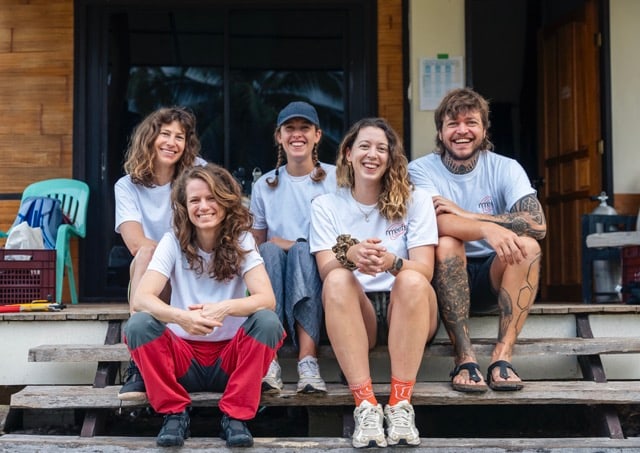
left to right: Dr. Ulrike Pfreundt (Co-CEO), Hanna Kuhfuss (Chief Field Operation & International Relations (CFIR)), Marie Griesmar (COO), Josephine Graf (Co-CEO), Mauro Bischoff (Head of Production)
How rrreefs is turning coral reef regeneration into a scalable business
Four female founders, one mission: save coral reefs – and build a profitable business doing it. What started in 2019 with a single reef installation in Colombia is now a growing company with projects across five countries. In this interview, the rrreefs team explains how they quadrupled revenue to CHF 350k in two years, why they rejected the traditional VC path, and how decentralized scaling through local partners has become their key to success.
OOMNIUM: From a single crowdfunded reef installation in Colombia to paid projects across five countries – how did you manage to turn pure passion for the ocean into a revenue-generating business?
Marie Griesmar: The passion has never gone away. If anything, it's grown stronger as we have seen what is possible. But from very early on, we knew that passion alone would not save coral reefs at scale. So, we focused on building relationships and creating value for companies, giving them tangible benefits like biodiversity data, storytelling material, and employee engagement. By 2023 we had our first paying customers, and from there it was about proving the model, refining our service, and showing that reef regeneration could be an attractive business proposition, not just a feel-good initiative.
OOMNIUM: You've grown your revenue from CHF 80k to around CHF 350k in two years while doubling your gross margin. What were the critical decisions that enabled this growth?
M.G.: Three decisions stand out for us. First, we concentrated on sales: understanding our customers' needs, who we were targeting, and what our value proposition was for each client. Making sure we had sufficient revenue to actually implement projects and deliver results with our reefs. Second, we invested in marketing and storytelling around our projects and partnerships. This helped build our brand and contributed to raising awareness of reef regeneration as a solution that businesses can invest in. Third, we invested in building a local production and implementation hub in the Philippines, which cut our costs by over 50%. That decision was transformative, it did not just improve our margins, it also proved that our decentralized model could work and gave us a template we can replicate in other regions.
OOMNIUM: Coral reef regeneration is not yet a standard corporate budget item. How did you convince your first clients like Accor Group, Lufthansa/Edelweiss, or Zurich Insurance to invest?
M.G.: Our customers get more than just a reef, they get a full service that addresses their business needs. For a hospitality company like Accor, a healthy reef protects their hotels' coastlines, attracts guests, and gives them a credible sustainability story. For a corporate partner, we provide biodiversity data for ESG reporting, content for employee engagement, and a visible commitment to nature that goes beyond offsetting. Framing our solution as a package of tangible, documented benefits makes conversations much easier.
OOMNIUM: If this financing round goes according to plan, where will rrreefs stand in two years?
M.G.: In 2028, our goal is to be profitable and no longer dependent on external funding to operate. We are targeting around CHF 3m in revenue by 2028, with around 4000m² of reef regenerated. We also want to be ready to enter the coastal protection market, making our reef system fit for coastal resilience applications and positioning ourselves in a growing adaptation market alongside our existing biodiversity and tourism segments. And we will be preparing for our first hectare-scale projects, which is a milestone we have been building towards since the beginning. More importantly, we will have a proven, replicable franchise model with additional local hubs operating across different regions, which is really the foundation for everything that comes after.
OOMNIUM: Decentralised scaling through local partners is a core part of your strategy. How do you ensure that quality and impact remain consistent while you grow globally?
M.G.: We have invested in developing clear standards and processes for production, installation, training, and monitoring, so that quality does not depend on the Swiss team being physically present at every project site. Training is a central part of this: we certify local reef builders through a structured program, who then train the next generation of builders through a train-the-trainer model. We stay in close communication with local teams to support them as they grow. The scientific rigor remains centralized. R&D, monitoring methodology, and quality control stay with the Swiss team, while implementation is local. That split is what keeps us both scalable and consistent.
OOMNIUM: As a four-member, all-female founding team, you're still an exception in the Swiss startup landscape. What unique challenges and strengths have you experienced?
M.G.: We do notice that a female-founded team, especially four female founders, is still rare in the startup landscape. Sometimes we get the feeling that there are certain stereotypes about us and rrreefs such as that we are doing charity rather than building a real business. But honestly, most encounters have been positive. We think that our real strength lies in the team. All four of us have been fully committed to rrreefs for five years, driven by a genuine shared purpose. There is a depth of trust and a way of working together that we think is quite unique. We also bring very different backgrounds and perspectives to the table: marine science, fine arts, field operations, international relations and business. That interdisciplinary mix has been one of our biggest advantages. And leading with compassion, in a world where that is not always the norm, turns out to be a strength too.
OOMNIUM: What advice would you give to other founders planning their first financing round — especially if building an impact business with long development cycles?
M.G.: From our experience, it makes sense to focus on generating sales traction and delivering real results early. Showing investors paying customers and proof that the business model works, especially in a market that is still being built, gives you credibility and makes fundraising conversation much easier.
Take time to think carefully about what kind of investors and funding structure actually fits your business. We learnt that the classic VC path was not right for us. The expected timelines, return perspectives, and pressure towards a short-term exit don't align with how we want to build rrreefs. Knowing that early saves a lot of time spent on the wrong conversations.
Finally, we have put a lot of effort into building a strong brand and a wide network. People invest in people as much as in businesses, and if they already know and trust you, the conversation starts from a very different place.