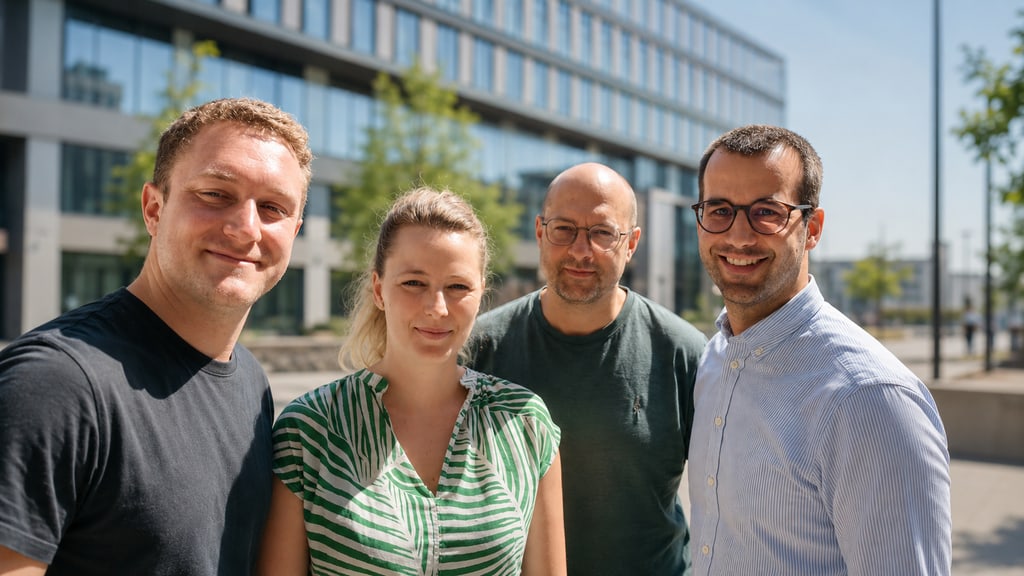
GoCalma Team Alex Bachelor, Uli Pieta with Co-Founders Claudio Beffa and Mathias Brenner
How GoCalma turns Swiss paperwork into real savings
Every Swiss household has that overstuffed Folder full of contracts, pension statements, and policies no one has read in years - alongside hidden financial losses no one has noticed. For the GoCalma founders, the problem became painfully clear when a routine road trip and a mortgage renewal revealed thousands of francs in overinsurance and missed savings. In this interview, they explain why the true opportunity isn’t another tax or banking app, but the document layer beneath them, how their B2B2C launch with fiduciary firms can scale to 200,000 users, and why building a team that outgrows them matters more than any exit.
OOMNIUM: There are tools for taxes, tools for retirement planning, tools for banking. You decided not to tackle any of these categories directly, but instead to address the document layer underneath them. Why is that the right place to start—and why hasn’t anyone done this before?
Mathias Brenner: The fact that so many tools already exist is actually part of the problem. None of them talk to each other, and instead of creating clarity, they add to the noise. The document layer is the right place to start because it solves a real, immediate problem: people's documents are scattered across physical folders, email inboxes, and various online portals. Just bringing everything together in one secure, digital place already delivers value. But the real power comes from what's possible once documents are centralized, being able to interact with them, ask questions, and actually understand what you own, owe, and need. A pension statement you can't read is just as useless digital as it is in a drawer.
OOMNIUM: You’ve both already been through exits—Mooris with Claudio, Sherpany with Mathias. What specific lessons have you taken from these experiences that make GoCalma stronger today? And what are the steps toward an exit with GoCalma?
M.B.: The biggest lesson is about the team. You can have the right market, the right product, the right timing, but none of it works if you don't genuinely believe in the people around you and give them the space to grow. That means entrusting your team early, before it feels comfortable to do so. The goal is to build something that outlasts your own involvement in every detail,to make your team outgrow you. That mindset shapes how we hire, how we delegate, and how we think about the long-term at GoCalma.
OOMNIUM: Two fiduciary firms have already confirmed GoCalma for the summer. Why are you launching through the B2B channel rather than directly to end customers—and what does your path look like from the first ten pilots to 200,000 users?
M.B.: Three reasons. First, fiduciary firms already see the shift coming,they know the landscape is changing and that staying relevant means adapting to what users actually need. Second, the document management problem is the same whether you're an individual or a firm managing hundreds of clients; it's just a different scale. And third, the B2B2C model is a strong distribution lever: every new business partner brings a cohort of users onto the platform. The ten pilots this summer give us real-world feedback and credibility. From there, the path to 200,000 users runs through both continued B2B expansion and the organic virality that comes when users start recommending GoCalma to people in their lives.
OOMNIUM: Of the CHF 500,000 you’re raising in this round, 60 percent will go toward product development, 20 percent toward user acquisition, and 20 percent toward operations and the ESOP. What is the one milestone that will prove to you that the capital was put to good use?
M.B.: In a few years, GoCalma should feel as natural to people in Switzerland as Twint or the SBB app. If we get there, it means the product earned its place in people's daily lives, and the acquisition investment found the right audience. That's the measure that matters to us.
OOMNIUM: GoCalma processes sensitive financial documents. How do you handle data protection—and how do you convince someone who has never shared their pension fund statement digitally to do so now with your app?
M.B.: Two things have to be true at once: the product has to be technically sound, and the company behind it has to be worthy of trust. On the technical side, before any document interacts with a generative AI model, sensitive personally identifiable information is stripped out locally. The LLM needs context to be helpful, but it doesn't need to know your name, your AHV number, or your account balance. But beyond the architecture, there's something more fundamental. People are sharing sensitive documents with tools like ChatGPT or Claude every day, because the utility is real. What we're offering is that same quality of experience or even higher, built by a Swiss company that genuinely understands the weight of what's being entrusted to it. We're not a platform that happens to handle financial documents, we're a company that was built around that responsibility from day one. For us, data protection isn't a compliance checkbox; it's core to what GoCalma is.
OOMNIUM: What advice would you give to a founder looking to raise a round through OOMNIUM? Specifically, what should they know, prepare, or approach differently than you might have expected?
M.B.: The structured process OOMNIUM runs isn't just a fundraising mechanism; it pushed us to revisit, sharpen, and in some cases fundamentally rethink parts of our strategy. That's a genuinely valuable by-product of the collaboration, not just a side effect. Founders who treat the process as a formality will miss the real opportunity. Those who engage with it seriously will come out with a stronger company, regardless of the outcome.